
The market is shifting rapidly, and you feel the growing gap. Your internal teams are executing disjointed creator campaigns. They deliver fragmented reports that fail to show true ecosystem impact and you’re having trouble setting benchmarks. Even as you think about designing next year’s fiscal budget, the anxiety sets in. You know creator marketing is the definitive strategic pillar of the future. But your current in-house infrastructure cannot scale to meet the $43 billion market reality. Incremental internal efforts will leave you completely outpaced by agile competitors. It is time to stop experimenting and start engineering an enterprise-grade creator engine.
Executive Summary: The Enterprise Mandate
- The Market Reality: U.S. creator ad spend will hit $43 billion in 2026. You must scale immediately.
- The Storytelling Shift: Creators are now your primary brand storytellers. They hold the cultural capital traditional advertising lacks.
- The AI Imperative: Large Language Models rely heavily on creator content. You must dominate this digital conversation to win search.
- The COPE Engine: Maximize your content return on investment. Mature brands Create Once and Publish Everywhere across all channels.
- Platform Accelerants: Global scale requires powerful enterprise software. Platforms like ZED, CreatorIQ, Captiv8, or Sprout Social are mandatory.
The Race to Scale: Accelerating Your Creator Strategy
The creator economy is accelerating at a breakneck pace. U.S. creator ad spend will reach $43 billion in 2026. This data comes from the IAB 2025 Creator Economy Report. This sector outpaces traditional media growth dramatically.
Competitors are building massive, always-on content ecosystems right now. Pioneering agencies like IZEA have tracked this evolution for twenty years guiding over 1,500 brands to maturity. If you are running one-off campaigns, you are falling behind.
Creators are the new, definitive brand storytellers. They hold the cultural capital traditional advertising completely lacks. Consider the massive 2026 FIFA World Cup. A traditional television commercial will get completely lost. You need creators broadcasting the authentic experience live from the road trip to the pitch.
The AI Search Imperative: How Creators Fuel LLMs
Search behavior has fundamentally changed. When consumers ask ChatGPT, Gemini, or Claude which brand to trust, which product to buy, or which service to use, those models don’t pull from your homepage. They pull from the broader digital conversation your brand either owns or doesn’t.
Large language models are trained on and continuously index user-generated content: Reddit threads, creator blogs, YouTube video transcripts, TikTok captions, and community forums. If creators aren’t discussing your brand, AI has little to say about it. Or worse, surfaces a competitor who invested in that conversation.
Three ways creator content directly influences AI visibility:
- Volume creates signal. LLMs weight topics with high content density more heavily. A brand with 50 creator posts generates a richer, more authoritative signal than one with five, even if those five are higher production quality. Always-on creator programs compound this advantage over time.
- Specificity gets cited. AI models prefer concrete, specific claims over vague brand language. A creator saying “I switched to this brand because of its 72-hour battery life and the warranty process took two days” gives an LLM far more citable material than “this brand is amazing.” Brief creators on specificity including real use cases, actual outcomes, honest comparisons.
- Third-party language signals authenticity. LLMs are trained on human writing and have learned to recognize promotional voices. Creator content that sounds authentic including mild criticism or honest trade-offs carries more weight in AI outputs than polished brand copy that triggers spam-adjacent patterns.
What this means for your content strategy:
The brands that will dominate AI-generated search results in 2027 aren’t necessarily the ones with the biggest ad budgets. They’re the ones flooding the digital ecosystem with high-quality, specific, authentic creator narratives today. Every brief you write is a signal investment. Every creator post is a building block in your AI search presence.
Track your brand’s share of voice in AI-generated responses the same way you’d track organic search rank. Make AI visibility a KPI alongside traditional social metrics.
The Four Stages of Enterprise Creator Maturity
To seize this momentum, leaders must benchmark their maturity right now as a starting point to map:
- Where are we now?
- Where do we want to be by the time we budget for 2027?
- What is the gap to get there?
- How do we fill it, and fast?
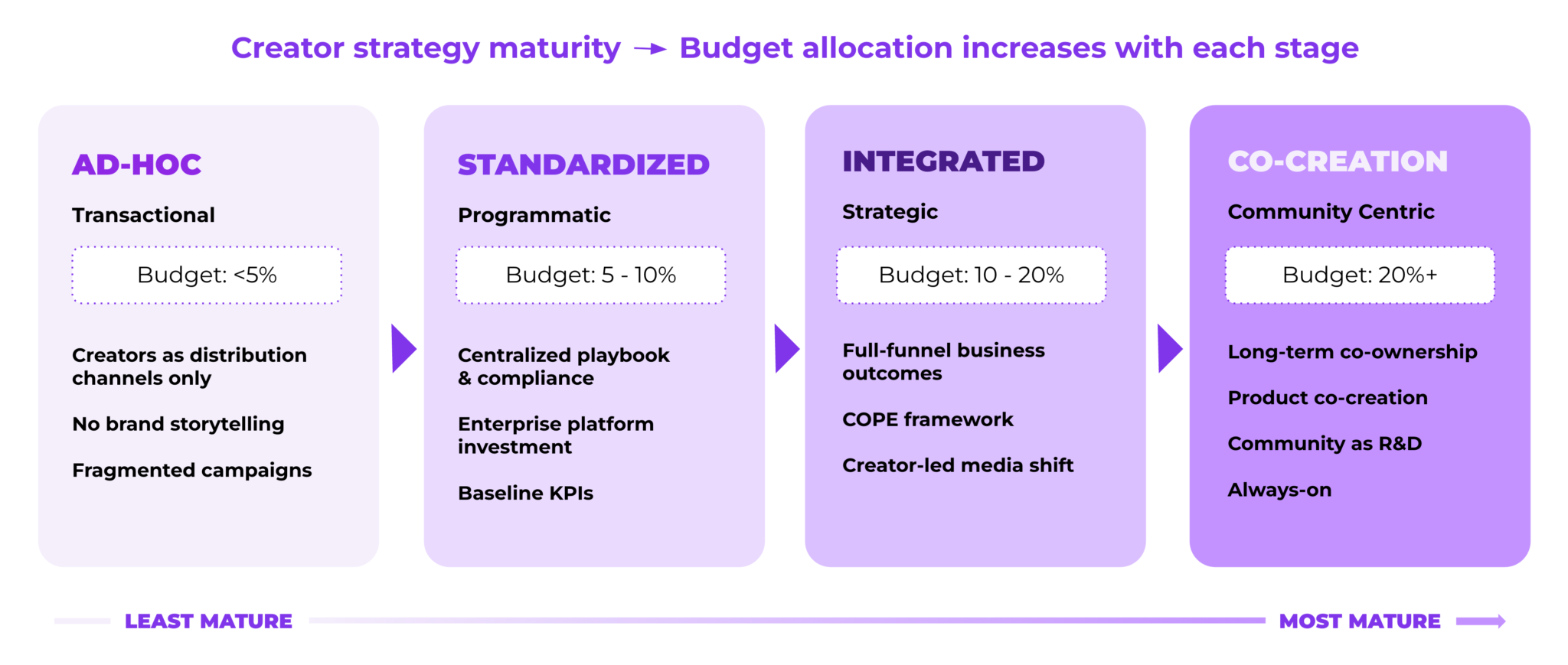
Stage 1: Ad-Hoc and Transactional (Least Mature)
- Spend: Brands typically spend under five percent of digital budgets here.
- Strategy: Brands treat creators merely as temporary distribution channels. Campaigns are uncoordinated across different internal marketing teams. Brand storytelling is completely absent in this phase.
- Solution: Establish concrete baseline performance metrics immediately. Audit these fragmented efforts to escape this tactical trap.
Stage 2: Standardized and Programmatic
- Spend: Brands allocate five to ten percent of total digital budgets. Funding shifts from general experimental pools to dedicated creator lines.
- Strategy: Maturing programs focus on streamlining operations and driving efficiency. Brands build centralized playbooks for contracts and legal compliance. Centralized measurement frameworks establish vital baseline performance benchmarks.
- Solution: Invest in enterprise software immediately. Platforms like ZED, CreatorIQ, or Captiv8 are mandatory. For example, ZED is built upon two decades of proprietary data. It seamlessly connects brands with proven creators. Software centralizes complex operations and removes severe legal bottlenecks.
Stage 3: Integrated and Strategic
- Spend: Brands shift ten to twenty percent of paid media budgets. They move funds from traditional digital ads to creator-led media.
- Strategy: Brands connect creator performance to full-funnel business outcomes. Think of beverage brands like Poppi dominating Coachella. Creators tell the authentic story; the brand amplifies it.
- Solution: Adopt a Create Once, Publish Everywhere (COPE) framework. Shift traditional advertising budgets directly to creator-led media. Repurpose top-performing creator assets across your entire marketing ecosystem.
Stage 4: Co-Creation and Community-Centric (Most Mature)
- Spend: Leaders allocate twenty percent or more of overall marketing budgets. Unilever shifted massive traditional budgets directly into creator ecosystems.
- Strategy: Partnerships evolve from short-term sales into long-term co-ownership models. E.l.f. Beauty and Shark Ninja reportedly co-create product lines alongside trusted creators or with creator input. Audience ecosystems transform into permanent community focus groups.
- Solution: Broker high-level, long-term talent partnerships immediately. Transform influencers into true enterprise storytellers and community leaders. Executing this requires massive talent access. IZEA utilizes a vetted network of over four million creators to broker these partnerships.
The IZEA Creator Maturity Checklist
- Broker high-level, long-term talent partnerships.
- Transform influencers into true enterprise storytellers and community leaders.
- Repurpose top-performing creator assets across your entire marketing ecosystem (COPE).
- Be poised to jump on any cultural moments in real-time, becoming part of the conversation. (i.e. maintain an always-on, pre-vetted network of agile creators).
- Allocate twenty percent or more of overall marketing budgets to creator marketing.
- Establish concrete baseline performance metrics and connect creator performance to full-funnel business outcomes; measure true incrementality alongside standard return on investment.
- Streamline operations to drive efficiency and effectiveness
- Build centralized playbooks for contracts and legal compliance.
- Leverage creator content to drive search results across search engines and AI results.
- Invest in enterprise creator economy operations platforms like ZED, and partner with a pure play influencer marketing agency versus a holdco or executing in-house.
Proving the ROI: Measuring Brand and Net-New Demand
How do CMOs justify shifting millions into creator marketing? What exactly are they telling the Board of Directors to receive a room full of AH-HA’s and head nodding?
They must report effectively on both brand and demand. The traditional marketing funnel has forever changed. Consumers move from discovery to purchase in a single scroll.
Brands must prove these campaigns generate net-new demand. Do creators simply cannibalize existing paid search and social channels? Data proves they do not steal existing intent. Instead, creators spark new interest among entirely untapped audiences.
Measure true incrementality alongside standard return on investment. Map creator content directly to new customer acquisition metrics. Influencer marketing agency partners like IZEA can help you create these narratives, supported with data, to ease through 2027 budgeting.
Overcoming the Five Roadblocks to Enterprise Scale
Enterprise scale introduces complex roadblocks that cripple unprepared marketing teams.
1. Global Scaling
- Trap: Scaling globally is nearly impossible in-house. Local tax laws and cultural nuances create massive bottlenecks, among other logistical and cultural issues (timezones, languages, payments, trends).
- Solution: Utilize managed service partners with global infrastructure. You need local nano-creators to capture regional World Cup excitement. This ensures localized authenticity while maintaining centralized corporate oversight.
2. Brand Safety at Scale
- Trap: Manual creator vetting completely fails at the enterprise level. Human teams cannot review thousands of past videos and captions.
- Solution: Deploy AI-driven software to scan historical creator content automatically. Artificial intelligence analyzes millions of posts to guarantee brand safety. IZEA applies these exact AI safeguards across its entire network. This protects enterprise brands while analyzing millions of data points across social platforms and creators.
3. Regulated Industry Compliance
- Trap: Regulated industries demand incredibly rigorous compliance workflows. Finance and healthcare face severe regulatory penalties. Simple FDA violations cost companies millions of dollars.
- Solution: Implement enterprise software with locked approval workflows and disclosures. Maintain strict legal guardrails without sacrificing authentic creator voices.
4. Cultural Agility and Trend Reaction
- Trap: Traditional advertising takes months to produce and approve. Culture moves in hours or days, not months. When McDonald’s launched the Arch burger, agile competitors reacted instantly. Brands lacking speed miss massive cultural capitalization opportunities.
- Solution: Maintain an always-on, pre-vetted network of agile creators. Build rapid-response budgets to participate in fast-moving cultural moments organically.
5. Creators as R&D Engines
- Trap: Brands often treat creators strictly as final marketing channels. They ignore the massive insights these communities generate daily.
- Solution: Use creator feedback loops as an early product R&D engine. Let creators test prototypes and guide future product roadmaps directly.
Assess Your Creator Marketing Maturity
Answer 6 questions to find your maturity stage. Tap an option to select it.
Frequently Asked Questions: Scaling Enterprise Creator Strategy
Q: What is the Creator Strategy Maturity Model?
A: It is a strategic framework for enterprise brands to benchmark their creator marketing operations. It spans four distinct stages. These stages range from ad-hoc, siloed campaigns to fully integrated, community-centric co-creation.
Q: How much should enterprise brands budget for creator marketing?
A: Budget allocation depends entirely on your current maturity stage. Emerging programs typically spend under five percent of digital budgets. The most advanced enterprise brands allocate twenty percent or more of their total marketing budget.
Q: What does the COPE framework mean in creator marketing?
A: COPE stands for Create Once, Publish Everywhere. It is a strategy designed to maximize content return on investment. Brands repurpose high-performing creator videos across paid social, email, website pages, and traditional advertising channels.
Q: How does creator marketing impact AI search results?
A: Large Language Models rely heavily on user-generated content. AI engines index creator posts and community blogs to answer consumer queries. Flooding the digital ecosystem with authentic creator narratives ensures positive and dominant AI search visibility.
Q: How can CMOs prove creator marketing ROI to the board?
A: CMOs must measure true incrementality alongside standard return on investment. Advanced measurement proves creator campaigns spark net-new demand. The data shows they do not simply cannibalize existing paid search or social channel intent.
Q: Why is scaling a global creator program internally so difficult?
A: In-house teams struggle with severe administrative and compliance bottlenecks. Global scale requires managing varying local tax laws, currency conversions, and cultural nuances. Managed service partners provide the necessary infrastructure to maintain localized authenticity globally.
Q: How do brands ensure brand safety across thousands of creators?
A: Manual vetting fails completely at the enterprise level. Human teams cannot physically review thousands of historical videos. Brands must deploy AI-driven enterprise software to automatically scan millions of posts and guarantee brand safety.
Q: What types of creator content are most likely to be cited by AI models?
A: LLMs prioritize content that is specific, third-party, and high-volume. Creator posts that include concrete product details, real outcomes, and authentic comparisons — rather than generic praise — generate stronger AI search signals. Always-on programs that produce sustained content density outperform one-time campaign spikes in long-term AI visibility.


John Francis is the Vice President of Sales & Marketing Operations at IZEA Worldwide (NASDAQ: IZEA), a full-service creator economy agency. Powered by its proprietary ZED technology, IZEA provides comprehensive influencer marketing solutions for brands. Since 2006, the agency has facilitated nearly 4 million brand-creator collaborations and partnered with over 1,500 brands. John leads the go-to-market strategy for IZEA’s enterprise services, working directly with marketing leaders at Fortune 500 companies across the CPG, media and entertainment, mobility, and consumer electronics sectors.