
Executive Summary: Discoverability strategy is the evolution of traditional SEO for AI-mediated search. With 68% of Google searches now ending in zero clicks to a website, brands must optimize for AI citations rather than just inbound traffic. A complete discoverability strategy integrates Generative Engine Optimization (GEO), Answer Engine Optimization (AEO), and Search Engine Optimization (SEO). It utilizes creator content to build the authority, structure, and repetition signals required to be recommended by AI engines.
The traditional search playbook is officially obsolete. For two decades, marketing teams built their digital strategy around a single core assumption: rank high on Google, drive traffic to a website, and convert the visitor.
That model is breaking. Search is not disappearing, but it has fragmented into a multi-platform, AI-mediated ecosystem where consumers get definitive answers without ever clicking a link.
Brands that only optimize for Google organic rankings are competing for a rapidly shrinking share of consumer attention. Winning the next era of digital marketing requires shifting from a “search ranking” mindset to a comprehensive Discoverability Strategy.
1. The Zero-Click Reality and the Linear Funnel
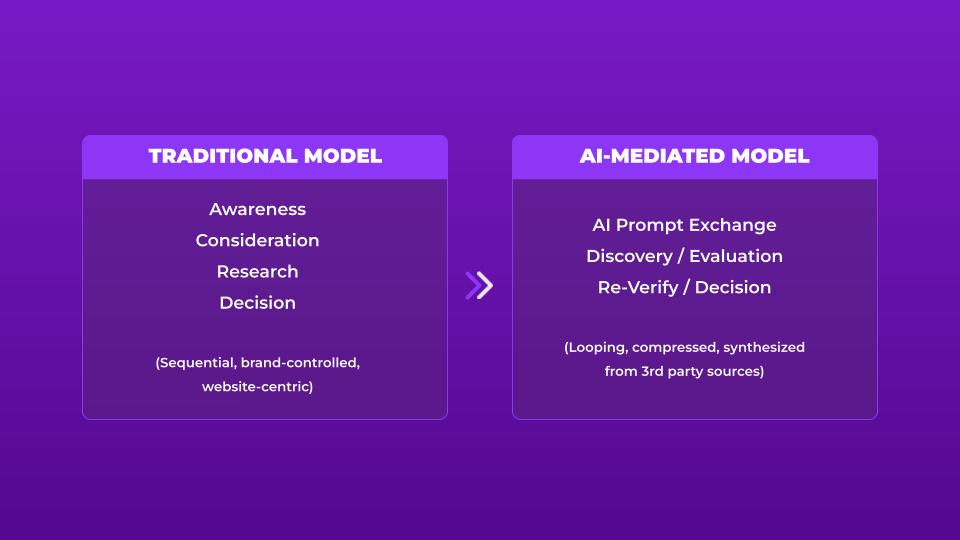
The traditional buyer’s journey used to be linear: Awareness leading to Consideration, Research, and Decision. Today, zero-click search is default consumer behavior, and AI is compressing those steps into a single interaction.
- 68% of Google searches now end without a single click to a website, up from 50% in 2019 (Similarweb / Search Engine Land, 2026).
- AI Overviews appear on 48% of all Google queries, up from 31% in early 2025.
- Zero-click rates jump to 83% when an AI Overview is present.
- Organic CTR drops by 61% for queries where AI Overviews appear.
- 53% of Gen Z consumers turn to TikTok, Reddit, or YouTube before Google.
2. The Discoverability Stack: SEO, AEO, and GEO
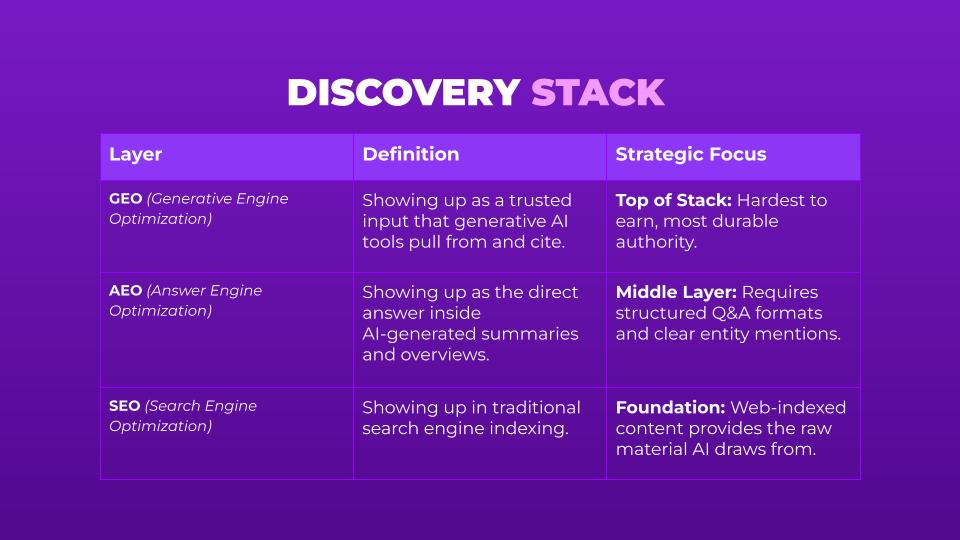
Many marketing teams treat AI search optimization as a new, isolated channel. In reality, discoverability is a connected, three-layer stack.
3. What AI Recommendation Engines Actually Reward
AI models parse context and meaning rather than just counting keywords. To be recommended, a brand must generate three specific machine-readable signals:
Signal 1: Third-Party Authority
AI systems weigh source credibility before surfacing a brand claim.
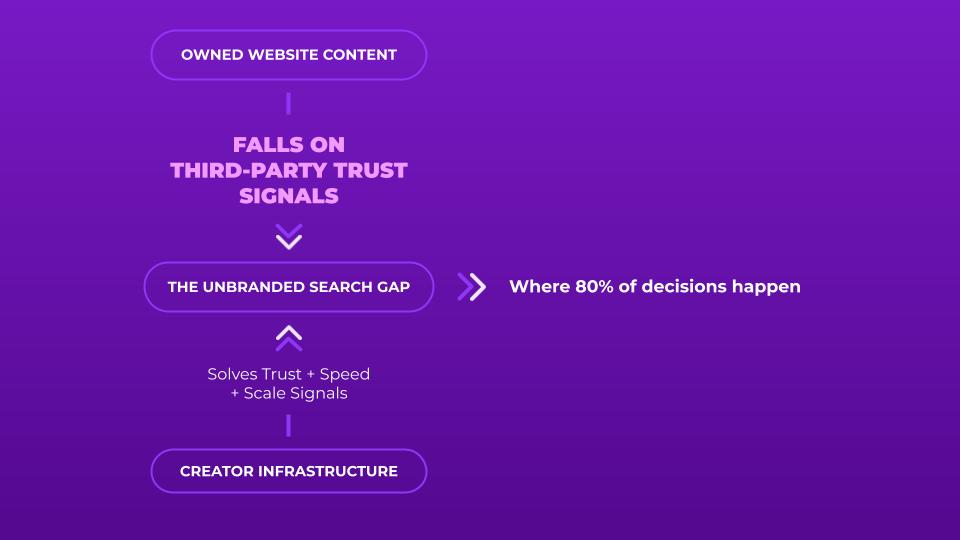
- 80%+ of LLM citations come from third-party and earned media, not brand-owned websites (Acceleration Partners, Oct 2025).
- Brands cited inside AI Overviews earn 35% more organic clicks.
Signal 2: Repetition & Cross-Platform Consistency
A single claim made on an owned brand site carries little weight with an LLM. However, when that same claim is echoed across dozens of independent creators, Reddit threads, and YouTube videos, the AI identifies it as reliable consensus.
- Repetition creates familiarity → Familiarity creates trust → Trust creates recommendation.
Signal 3: Structure & Entity Clarity
AI systems require explicit context. Explicitly naming the brand, using clear Q&A headers, and structuring content around specific use cases helps AI models extract and attribute information correctly.
4. Creator Content as Discoverability Infrastructure
The biggest strategic evolution in the creator economy is a shift in purpose: Creators are no longer just an awareness tactic; they are critical discoverability infrastructure.
The Unbranded Search Gap
A brand can easily own its branded search terms (e.g., searching the exact brand name). The vulnerability lies in unbranded search (e.g., “best protein bar for weight loss” or “top CRM for small teams”).
Unbranded queries are dominated by YouTube comparison videos, Reddit threads, and creator listicles. When a user asks an AI assistant for a recommendation, the AI synthesizes its answer from those exact third-party creator sources.
Why Creator Content Works as Infrastructure
- Third-Party Validation: Creator recommendations provide the independent trust signal that humans and LLMs prioritize.
- Speed to Index: Creator content on YouTube and TikTok gets indexed and cited by AI models within days or weeks. Traditional domain authority building via web SEO can take 900+ days (Ahrefs).
- High Specificity Over High Reach: Long-form video accounts for 94% of AI citations (OtterlyAI 2026). Furthermore, 40.83% of AI-cited videos have fewer than 1,000 views. AI models cite for specificity and context, not view counts.
Balancing Creator Tiers for Maximum Signal
- Subject-Matter Experts (Niche Authority): A 2,000-subscriber dermatologist reviewing a skincare ingredient will out-cite a 2-million-subscriber lifestyle creator in AI answers. Their primary value is providing citation-worthy trust.
- Scaled-Reach Creators (Volume & Repetition): High-reach creators drive upstream branded search demand and generate the widespread repetition signal AI systems reward.
5. Separating Signal from Noise
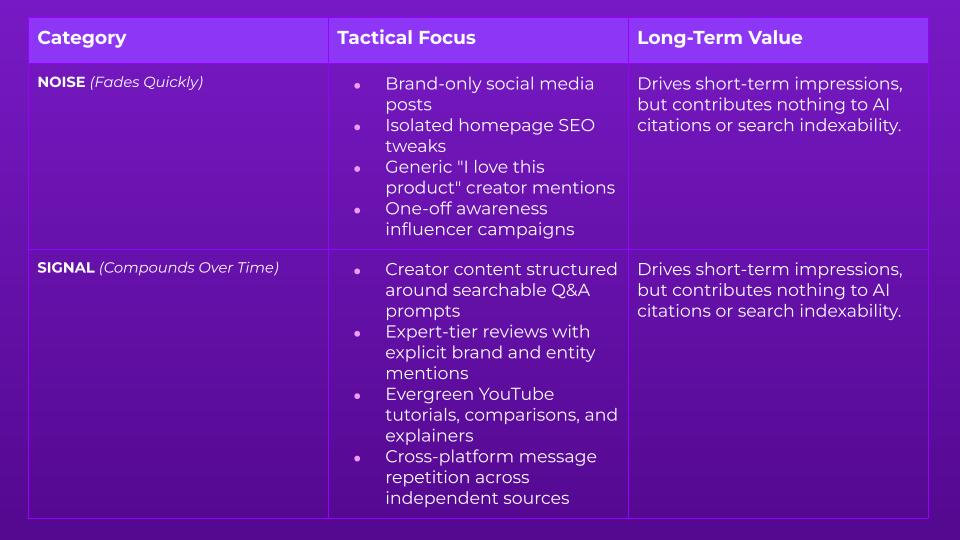
To build true discoverability, marketing teams must stop funding high-volume, temporary noise and invest in compounding discoverability signals.
6. The IZEA Discoverability Blueprint
Transitioning to a Discoverability Strategy requires a structured, three-phase operational plan:
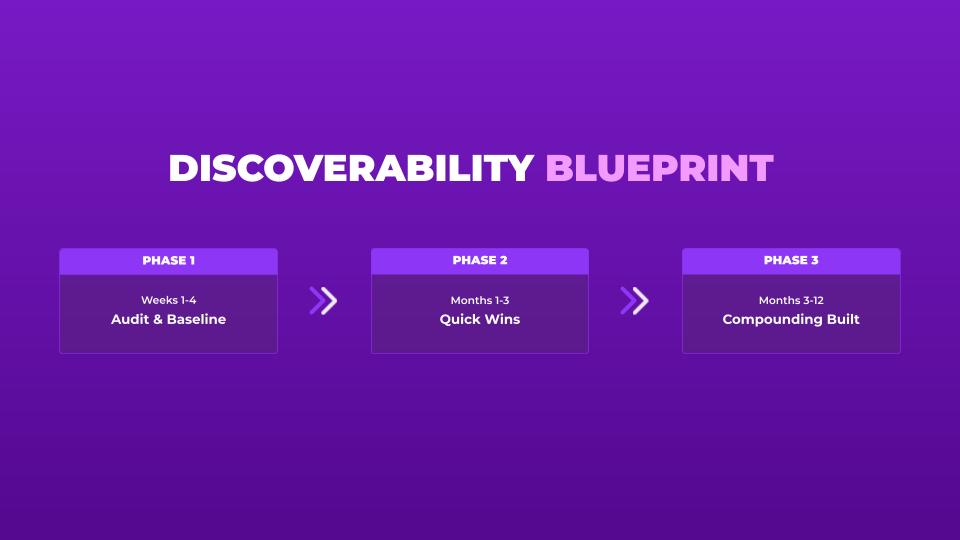
Phase 1: Audit & Baseline (Weeks 1–4)
Map your current discoverability gap before committing media spend:
- Branded Search Sweep: Audit what appears on page 1 for [Brand Name] review or [Brand Name] vs [Competitor].
- Unbranded Category Search: Search the top 5 to 8 questions your customers ask before knowing your brand across Google, YouTube, and TikTok. Identify who owns those results.
- AI Visibility Prompt Testing: Test unbranded category prompts across ChatGPT, Perplexity, and Gemini. Document whether your brand is cited, excluded, or if a competitor is recommended.
- Creator Footprint Review: Evaluate existing creator content for explicit entity mentions, Q&A formatting, and indexability.
Phase 2: Quick Wins (Months 1–3)
- Implement structured Q&A formats on owned assets.
- Activate expert-tier creators to fill critical AI citation gaps identified in the audit.
- Optimize creator briefs to enforce explicit entity naming and searchable video captions.
Phase 3: Compounding Build (Months 3–12)
- Scale creator activations across both expert and reach tiers.
- Drive consistent cross-platform repetition across YouTube, TikTok, Reddit, and key web publications.
- Shift measurement from basic campaign metrics (impressions, clicks) to Discoverability Metrics: Citation Rate, Recommendation Rate, AI Visibility Share of Voice, and Branded Search Demand Growth.
The Strategic Imperative
Organically generated website traffic will continue to face pressure from zero-click layouts and AI answer engines. The brands that win over the next decade will not be those with the best isolated website SEO, but those that show up consistently, credibly, and structured for recommendation across the entire search ecosystem.
Frequently Asked Questions
What is the difference between SEO, AEO, and GEO? Search Engine Optimization (SEO) helps web pages index and rank. Answer Engine Optimization (AEO) ensures content is structured for extraction inside AI summaries. Generative Engine Optimization (GEO) focuses on becoming a trusted source that generative AI models pull from and cite.
Why is zero-click search increasing? Zero-click search has become default behavior because AI Overviews and chat assistants resolve the user’s question directly on the search page. Currently, 68% of Google searches end without a website click.
How does creator content improve AI search visibility? Creator content acts as discoverability infrastructure. It provides the independent third-party trust, rapid indexing, and cross-platform repetition signals that AI models heavily reward when deciding which brands to recommend.


John Francis is the Vice President of Sales & Marketing Operations at IZEA Worldwide (NASDAQ: IZEA), a full-service creator economy agency. Powered by its proprietary ZED technology, IZEA provides comprehensive influencer marketing solutions for brands. Since 2006, the agency has facilitated nearly 4 million brand-creator collaborations and partnered with over 1,500 brands. John leads the go-to-market strategy for IZEA’s enterprise services, working directly with marketing leaders at Fortune 500 companies across the CPG, media and entertainment, mobility, and consumer electronics sectors.